
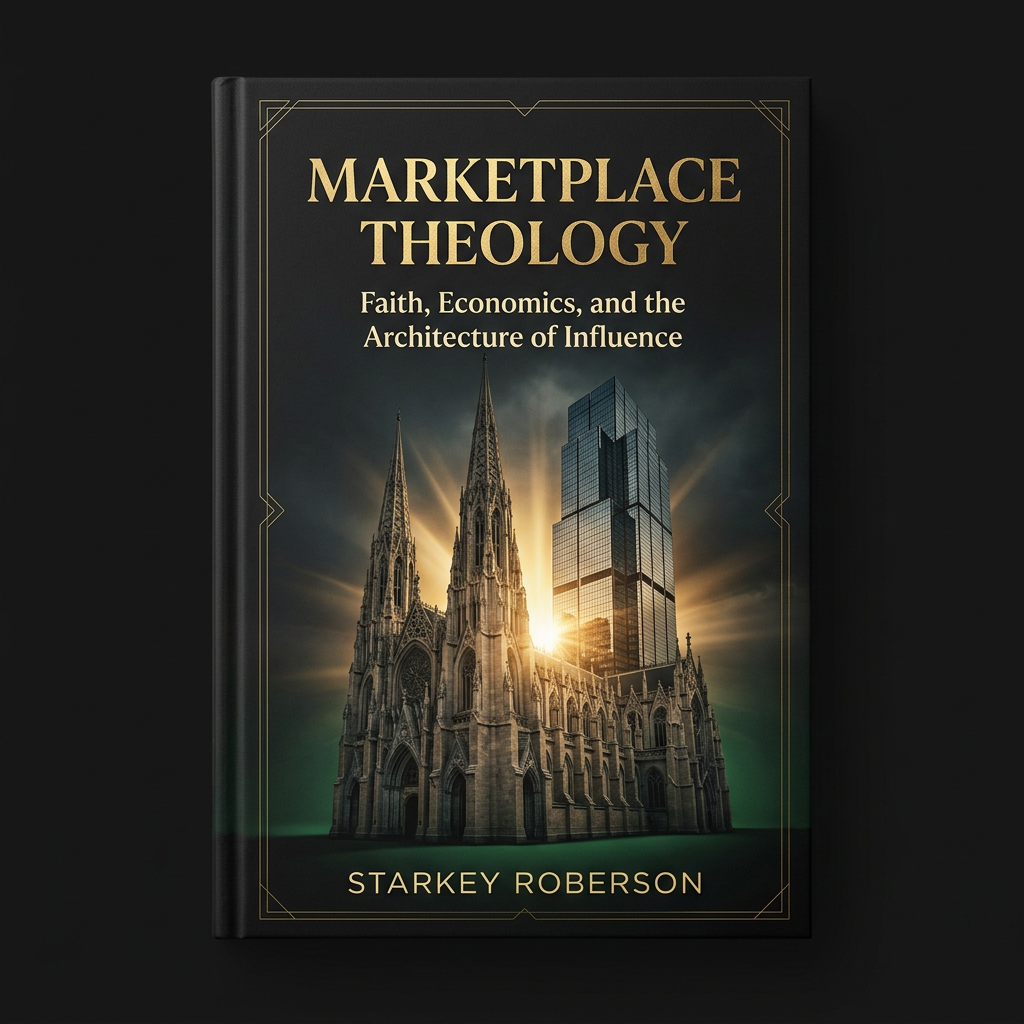
Starkey Roberson
Marketplace Theology
Faith, Economics, and the Architecture of Influence
Table of Contents
For generations, the sacred and the secular have been artificially separated. Faith was confined to pulpits, while commerce was relegated to boardrooms. Sunday belonged to God; Monday belonged to the market. This division—so deeply embedded in Western religious culture—has produced a fragmented worldview, one that limits the scope of divine purpose in the life of the believer and robs the marketplace of its highest potential.
The consequences of this fragmentation are everywhere. We see believers who are deeply devoted in their private spiritual lives but who operate with entirely secular frameworks in their professional ones. We see entrepreneurs who are excellent technicians but who lack any coherent moral or theological architecture undergirding their decisions. We see ministries that speak truth into culture but that remain economically anemic, dependent on donations rather than positioned as generators of generational wealth. The divide has cost us greatly.
Marketplace Theology challenges that divide at its root.
It asserts that the marketplace is not merely a space for economic exchange, but a primary theater of divine assignment. It is where values are shaped, cultures are influenced, and destinies are financed. The systems that govern buying, selling, hiring, and scaling are not neutral—they carry theological weight in both origin and consequence. How we build, what we build, who benefits from what we build—these are not merely strategic questions. They are spiritual ones.
This book emerges from a conviction I have carried for years: that the most urgent calling of this generation is not to retreat from the systems of this world, but to engage them—strategically, theologically, and with the full weight of divine authority. The problems that plague our economies, our communities, and our cultures are not simply political failures or market inefficiencies. They are, at their core, the result of systems designed without a theology of purpose.
Marketplace Theology is not a soft motivational concept. It is a framework—a blueprint—for those who sense that their calling extends beyond traditional ministry into systems, infrastructure, and economic influence. It is for the entrepreneur who wants to build more than a profitable company. It is for the executive who wants her organization to reflect something higher than shareholder value. It is for the young professional who feels the tension between faith and ambition and wants a framework that refuses that false choice.
We are entering an era where influence is no longer determined solely by voice, but by structure. The most powerful forces shaping human culture today are not sermons—they are platforms. Not declarations—but distributions. Not confessions of faith—but architectures of commerce. Those who understand this and build accordingly will shape the next century of human civilization.
This book is organized around the most critical concepts in Marketplace Theology: dominion, value creation, systems thinking, the architecture of influence, the proper role of wealth, the marketplace as mission field, integration versus separation, ownership, the economics of influence, digital infrastructure, the builder's mindset, strategic obedience, scaling, ecosystems, and the future. Each chapter builds upon the last, constructing a comprehensive theological-economic framework designed for those who are called to build.
A word about tone: this is not a devotional. It is a strategic text. The theology here is not decorative—it is structural. It will challenge some of the assumptions you have carried from religious culture and from business culture alike. That is intentional. The goal is not comfort. The goal is clarity. And clarity, in this domain, is rare and costly.
Let us begin.
The question is not whether systems matter.
The question is whether you will build them.